Black Friday Offer – Receive 25% off on your new hair system! Claim Your Offer

Can London Hard Water Dry Out or Discolour a Hair System?

Written by

Megan Brooks

SHARE ON
inspect
Table of Contents
inbox
Contact our specialists now for Hair Replacement!
Share this article

Introduction

Has your hair system started to feel rougher than it used to? Or does the colour look a shade duller than the day it left the studio? London’s water could be behind both.

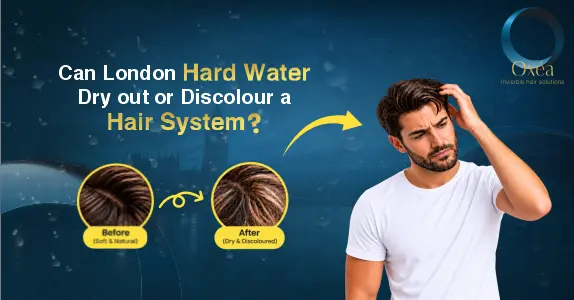
Hard water can dry out a hair system over time. In some cases, it also contributes to visible discolouration, particularly in lighter and human hair systems. This isn’t a sign that anything has gone wrong with your unit. It’s a predictable side effect of washing in one of the hardest water supplies in the UK, and it’s manageable once you know what’s causing it.

Since 2004, our trichologists and hairstylists have fielded this question at both our West Kensington and City of London studios. It isn’t unique to one postcode or one type of system. It’s a London-wide issue that most hair system care guides skip over entirely.

Quick Summary

London's water is hard to very hard almost everywhere. Mineral buildup from hard water can leave a hair system feeling drier and rougher over time, and lighter or grey-blended human hair systems are more likely to show subtle discolouration. Synthetic systems are less affected by dryness and colour change, though they can look flatter with buildup. A shower filter, the right shampoo, and regular professional deep cleans keep it under control. If you notice a change, bring it to a maintenance visit rather than guessing at home.

Is London's Water Actually Hard?

Almost certainly, yes. London sits on chalk and limestone geology. As rain filters through it, it picks up calcium and magnesium minerals along the way.

By the time that water reaches your tap, it’s classified as hard to very hard across virtually the entire capital. According to water hardness research by Aspect, every London borough tested falls into the hard or very hard category, with the hardest readings in boroughs like Barnet, Enfield and Harrow, and comparatively softer, though still hard, readings in areas such as Bexley, Lambeth and Camden. There isn’t a genuinely soft-water borough anywhere in Greater London.

In parts of the city, older pipework adds trace metals like iron and copper into the mix too. As Marvyn Duche, senior colourist at Paul Edmonds London, explains, “the pipes are very old, so the water contains a lot of metals” alongside the calcium. It’s part of why London hair professionals generally, not just those working with hair systems, treat hard water as routine rather than exceptional.

What Does Hard Water Actually Do to a Hair System?

Hard water carries dissolved calcium and magnesium, and in areas with older pipework, trace metals too. Every time you wash your hair system, some of that mineral content stays behind on the hair fibres rather than rinsing away completely.

This effect has been studied directly, though mostly on natural hair rather than hair systems. A scanning electron microscopy study in the International Journal of Dermatology found that hair washed in hard water developed a rougher, more mineral-coated surface than hair washed in distilled water, with visibly higher mineral deposition.

Findings on whether hard water actually weakens strand strength are more mixed: an earlier study in the International Journal of Trichology found no significant difference in tensile strength, while separate research has found the opposite. The surface effect, the roughness and dulling most clients actually notice, is the more consistent finding across studies.

How Does Mineral Buildup Actually Reach Your Hair System?

With each wash, a fine layer of mineral residue coats the outside of the hair strand. On its own, one wash makes no visible difference.

Over weeks and months, that residue builds up. It sits on top of the cuticle, the outermost part of each strand, and starts to block moisture and conditioning products from reaching the hair underneath.

Why Does Your Hair System Feel Rough or Dry After Washing?

This is usually the first sign clients notice. Mineral buildup roughens the cuticle and makes it harder for conditioner to do its job. The hair can feel coarser, look less shiny, and lose some natural movement, even right after a wash done correctly.

It isn’t a fault with the system. It’s the water reacting with the hair the same way it would with natural hair, just without a scalp producing natural oils to help offset it.

Can Hard Water Actually Discolour a Hair System?

It can, though it’s a slower and more subtle process than dryness, and it doesn’t happen to every system in the same way.

Is Your System More Likely to Show It If It's Light or Grey-Blended?

Yes. Mineral deposits can leave a faint dulling or slightly yellowish cast over time, and that’s far more visible against lighter blonde, grey, or silver-toned hair than against darker shades.

This matters more for premium human hair systems, because they’re colour-matched precisely to your natural hair. Even a small shift can be noticeable to you before it’s noticeable to anyone else.

How Can You Tell This Apart From Chlorine or Sun Fading?

Hard water discolouration tends to build gradually, showing up as an overall dulling or slight yellowing across regular washes rather than a sudden change. Chlorine exposure and sun fading behave differently and tend to happen faster.

If the change appeared right after a swim or a day in strong sun, that’s more likely the cause. If it’s crept in slowly through your normal washing routine, hard water is worth looking at first.

Noticing dryness or a gradual colour change in your hair system? Speak to Our Team

Does Hard Water Affect Every Hair System the Same Way?

Not quite. Both the hair type and the base material make a difference to how much you’ll notice it.

Does It Matter Whether Your System Is Human Hair or Synthetic?

Generally, yes. Human hair behaves like natural hair when it comes to mineral buildup, so it’s more responsive to hard water, for better and for worse. It can be treated and restored the same way natural hair can.

Synthetic fibre holds its shape and colour more independently of water quality. It’s less prone to dryness and discolouration, though it can start to look flatter or more weighed down with buildup over time.

Could It Be Affecting Your Base and Bond, Not Just the Hair?

Mostly, hard water’s effect stays limited to the hair fibres rather than the base or adhesive bond. That said, mineral residue can build up at the edges of the base over time, particularly with thin skin or poly bases.

It’s one more reason a professional deep clean matters more than it might seem.

Quick reference: hard water sensitivity by system type

System typeDryness riskDiscolouration riskBase/edge riskWatch for
Lace base
(human hair)
HighMedium–HighLow–MediumRoughness, tangling, reduced shine
Mono mesh baseMediumMediumLowDullness, less natural movement
Thin skin / poly baseMediumMediumMedium (residue at the base edge)Edge lifting, buildup near the hairline
Synthetic fibre systemsLow–MediumLowLowA flatter, more weighed-down look

How Can You Tell If Hard Water Is the Cause?

Because a hair system can change for several different reasons, it helps to know what you’re actually looking at before assuming it’s the water.

What Early Warning Signs Should You Watch For?

Look out for hair that feels rough or straw-like even straight after conditioning. Watch for a duller appearance that doesn’t respond to your usual products the way it used to, or a very gradual shift in tone rather than one obvious event.

Could Something Else Be Causing the Change in Your System?

Possibly. Over-washing, sun exposure, heat styling, and product buildup can all produce similar symptoms. We’ve covered those causes in more depth in our guide to keeping your hair system soft.


Chlorine exposure from swimming has its own distinct pattern, which we walk through in our guide to swimming with a hair replacement system. If you’ve ruled those out and the change built up gradually through your normal washing routine, hard water is the most likely explanation.

How Can You Protect a Hair System From Hard Water in London?

The good news is that none of this requires an overhaul of your routine, just a few adjustments that work alongside the care you’re already giving your system.

Should You Use a Shower Filter or Water Softener?

Either can help reduce the mineral buildup reaching your hair system in the first place. A shower filter is the lower-commitment option and a reasonable place to start. A whole-home water softener addresses the issue more comprehensively if hard water is affecting more than just your hair system.


Either works as a complement to your existing wash routine and professional maintenance, not a replacement for it.

What Shampoo Should You Use to Manage Mineral Buildup?

Look for a clarifying or chelating shampoo formulated to lift mineral deposits from the hair. Use it as an occasional addition to your normal hair system-safe shampoo rather than a full replacement, since these formulas can be more stripping if used every wash.

How Often Should You Deep-Clean to Remove Buildup?

This is best worked out with your stylist as part of your regular maintenance visits. It depends on your specific system, how often you wash it, and how hard the water is where you live.


A deep clean at your maintenance appointment is generally the more thorough option compared with anything done at home between visits.

The right products and maintenance can help keep mineral buildup under control. Book Your Free Consultation

When Should You Bring It to a Professional Instead of Treating It at Home?

If you’re noticing persistent dryness, a change in colour, or anything unusual around the base or bond, it’s worth bringing your hair system in rather than experimenting at home. A trained eye can tell the difference between mineral buildup, product residue, and normal wear far more reliably than trial and error can.


Correcting it early is much easier than reversing more established buildup later. This is exactly what your regular maintenance visit at our West Kensington studio or our City of London studio is designed to catch, often before it’s visible to anyone but you.

FAQ’s

No. Hard water can affect the hair fibres of the system itself, but it isn’t linked to hair loss underneath. If you’re noticing changes to your natural hair or scalp, that’s worth raising separately with your trichologist.

Not necessary, but a shower filter can help reduce the amount of mineral buildup your system is exposed to over time, especially if you wash frequently.

Hard water’s main effect is on the hair fibres rather than the bond itself, though mineral residue can build up near the base edge over time, which is one reason regular professional maintenance matters.

Yes. A professional deep clean is generally more thorough at removing accumulated mineral buildup than a standard at-home wash, which is why it’s built into regular maintenance visits.

 Both can be affected, but human hair systems tend to show dryness and discolouration more noticeably, while synthetic systems are more likely to look flat or weighed down rather than genuinely dry.

Normal wear tends to show up as gradual thinning or shedding related to the system’s lifespan. Hard water buildup shows up as dryness, roughness, and dulling that can often be improved with the right products and a professional deep clean, rather than being a sign the system needs replacing.

Author Profile

Megan Brooks

Megan Brooks is a Certified Trichologist at Oxea Invisible Hair Solutions with over 21 years of Unbeatable experience. Throughout her remarkable career, she has successfully completed an impressive 8000+ hair replacement systems. Megan is dedicated to transforming lives and boosting self-confidence so that one can live with all the pride. She has served over 800 satisfied clients and still-counting, while helping them regain their natural appearance and feel their best.


More from the blog

Book a Consultation

    Book a Consultation

      Have Questions?
      We're Here to Help