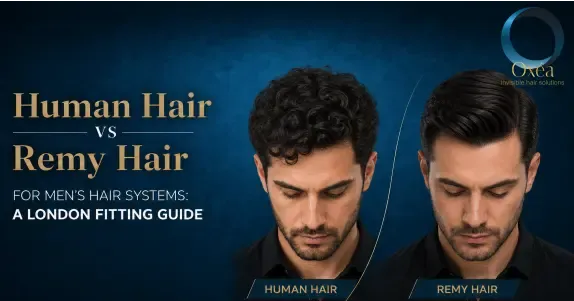
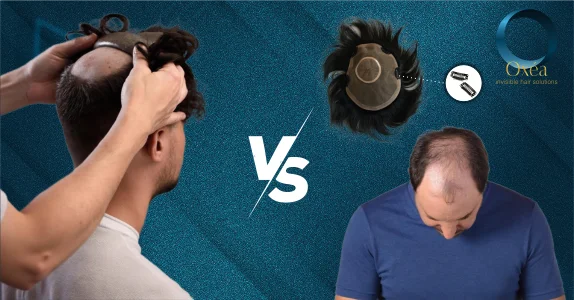
If you’re researching hair systems, you’ve probably come across the terms human hair and Remy hair mentioned side by side, almost as if they were two separate materials. They’re not quite that simple.
Remy is a grade of human hair, not a different material altogether, so when people compare “human hair” against “Remy hair”, they usually mean standard, non-Remy-grade human hair against the Remy grade. Understanding that distinction early on will save you a lot of confusion as you compare hair system options.
At Oxea London, we’ve been fitting hair systems from our West Kensington and City of London studios since 2004, and hair type is one of the first things our trichologists talk through with every client, well before density, base or colour come into it.
A human hair system, sometimes called a natural hair system, uses real human hair rather than synthetic fibre, which is why it’s the most common choice for anyone who wants a natural look and feel. Unless a system is specifically labelled Remy, it’s usually the standard, non-Remy grade.
It’s naturally soft, takes styling and colour well, and blends easily with your own hair. These human hair come from donors across the world, including India, China and Europe, and it’s more widely available than Remy-grade hair, so you’ll find it across a broad range of budgets and system types.
Remy takes that same human hair a step further. It’s not a separate material or a country of origin, it’s a quality grade that shows how carefully suppliers gathered and sorted the strands.
With Remy hair, every strand keeps its cuticle intact and aligned root to tip, running in one direction. This matters because misaligned cuticles are what cause hair to tangle and lose its shine over time.
Because the cuticle layer stays intact rather than being stripped or reversed during collection, Remy hair tends to feel closer to your own natural hair and holds up better against daily wear.
Once you separate the material from the grade, the comparison becomes much clearer. Here’s how the two actually compare inside a hair system:
| In a hair system | Human Hair (standard grade) | Remy Hair |
|---|---|---|
| Lasts longer? | Shorter lifespan, more delicate over time | Longer lifespan, better wear resistance |
| Looks and feels more natural? | Soft and fine, though it can show wear sooner | Closer to natural, healthy hair texture and shine throughout its life |
| Value over time | Lower upfront investment, may need replacing sooner | Bigger upfront investment, holds its quality for longer |
| Blends with your natural hair? | Blends easily across a wide range of textures and tones | Blends naturally too, with a texture that stays closer to your own hair throughout its life |
| How easy is it to recolour? | Takes recolouring evenly as it fades, straightforward to refresh | Can be trickier to match evenly once the colour does fade |
| How much upkeep does it need day to day? | Needs more processing before fitting, and can tangle if it isn’t cared for properly | Tangles far less day to day, though it still needs consistent professional maintenance |
| How accessible is it? | Widely available, making it a more accessible entry point | Less widely available, reflecting the bigger investment |
Neither option is automatically better. A standard-grade human hair system, properly maintained, can still look excellent and serve you well for a good while. Remy hair simply gives you a longer runway before you notice a change in quality.
This is really where the decision comes down to you, not the hair itself. A few honest questions can point you in the right direction.
If you stay active, swim regularly, or spend a lot of time outdoors, durability matters more, and Remy hair’s better wear resistance tends to pay off. If you like changing your colour every few months, standard human hair’s more forgiving recolouring behaviour might suit you better long term, even though Remy looks superb between colour changes.
If this is your first hair system and you’d rather test the waters with a ready-made option before committing to a custom Remy system, that’s a completely reasonable way to start. Many clients move from a ready-made system to a custom one once they know exactly what they want.
It’s also worth asking yourself how long you want to keep the same system before replacing it. If you’re happy to replace more often, standard human hair keeps your costs down. If you’d rather invest once and maintain it well, Remy usually suits you better long term.
Also Read: Playing Sports & Working Out with a Hair System: What You Need to Know
Human hair doesn’t go straight from a donor’s head into a hair system. It goes through a preparation process first, and understanding this helps explain why the two hair types behave differently.
To create density without using excessive amounts of hair, manufacturers fold each strand in half and knot it into the base, so one strand appears as two. This standard technique genuinely improves how full a system looks. The trade-off is that folding hair creates cuticle misalignment on one half of the strand, since the fold reverses its direction.
To manage this, processors typically treat standard-grade hair with a gentle chemical process that smooths the cuticle layer, so the hair sits flat and doesn’t tangle once it’s knotted into the base.
Remy hair avoids the need for this step in the first place, because collectors already gather and sort its cuticles in one direction before the hair ever reaches the knotting stage. This helps Remy hair remain smoother for longer, although manufacturing quality and aftercare also matter.
Also Read: How Long Does a Custom Hair System Take? From Consultation to First Fitting in London
London doesn’t get very hot or very cold, but that doesn’t mean it’s dry. Regular drizzle, humidity swings between seasons, and central heating through the winter months all affect how any hair system behaves, regardless of hair type.
Humidity can bring out more natural wave or frizz in standard human hair that’s had less processing, so you might notice you need slightly more styling on damp days. Remy hair, with its intact cuticle layer, tends to resist humidity a little better and holds its style for longer between touch-ups.
Neither hair type suits London dramatically more than the other. It’s more a case of adjusting your styling routine slightly depending on which one you’re wearing and the time of year.
Both hair types benefit from the same basic care principles, though Remy hair rewards a bit more consistency.
Wash your system with products designed for human hair systems rather than regular haircare, since ordinary shampoos can be too harsh for a bonded or fitted piece. Let it air dry where possible, and limit heat styling on either hair type, since heat speeds up wear regardless of grade.
Standard human hair tends to need slightly more frequent conditioning to stay soft, since it’s had more processing to begin with. Remy hair forgives you a bit more day to day, but it still needs regular professional maintenance appointments to keep the base secure and the colour looking fresh.
Whichever type you choose, a proper aftercare routine makes a bigger difference to how long it lasts than the hair type alone.
There isn’t a single right answer, and that’s genuinely fine. Standard human hair makes a sensible, natural-looking choice if you’re new to hair systems, want more flexibility with recolouring, or are working within a tighter budget. Remy hair is worth the extra investment if durability, shine and long-term texture matter most to you, and you’re happy to maintain it consistently.
An in-person consultation remains the most reliable way to decide, since a trichologist can match hair type to your actual hair, lifestyle and goals rather than a general comparison. At Oxea London, our team can help you compare both options and choose the one that feels right for you. Contact us to arrange your consultation.
Not quite. All Remy hair counts as human hair, but not all human hair used in hair systems meets the Remy standard. Remy refers specifically to hair with intact, aligned cuticles, while standard human hair, including most Indian hair, may not reach that processing standard.
Yes. Suppliers can process human hair from any origin, commonly India, China or parts of Europe, to Remy standard. Indian Remy hair, for example, is a widely used combination that keeps the hair’s natural softness while adding the durability of proper cuticle alignment.
This depends on how often you wear it, how you maintain it, and your stylist’s recommendation for your specific system, so it’s best discussed at your consultation rather than assumed from a general figure.
For many clients, yes, particularly if you want a system that holds its shine and texture over a longer period with fewer replacements. That said, it depends on your lifestyle, budget and how often you like to change your look, which a fitting consultation is designed to work through with you.
Not exactly, though people often compare the two. Virgin hair means hair that hasn’t been chemically treated, coloured or processed at all, while Remy specifically describes cuticle alignment. Virgin hair can be Remy or non-Remy grade, just as hair from India, China or Europe can be either. They’re two different ways of grading the same human hair, not competing categories.

Megan Brooks is a Certified Trichologist at Oxea Invisible Hair Solutions with over 21 years of Unbeatable experience. Throughout her remarkable career, she has successfully completed an impressive 8000+ hair replacement systems. Megan is dedicated to transforming lives and boosting self-confidence so that one can live with all the pride. She has served over 800 satisfied clients and still-counting, while helping them regain their natural appearance and feel their best.